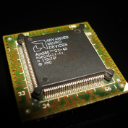
Posts tagged with Istanbul
How Low Can You Go?
Posted by John Fruehe in 10:19 pm
Back in April, when we introduced the Quad-Core AMD OpteronTM EE processors, Gordon Haff of Illuminata had this to say in his blog:
“Opteron EE is therefore not just your basic low-end-of-the-frequency-scale parts. Rather, they’re explicitly targeted for cloud computing and Web 2.0-in other words, the type of uses and customers who explicitly value power efficiency.”
Gordon points out that these processors are “not simply the fall-outs at the low end of the frequency range as lower power processors have often been historically.” We are specifically targeting low power consumption because we understand the power needs that customers have. We understand the environments and are targeting processors to meet those needs.
Those quad-core processors that were launched in April have an ACP of 40 watts, so if you do the very simple “watts per core” math (ACP / cores) you have ~10W per core. Of course that is not a scientific measurement (that would require much more complex testing because the simple math does not comprehend that there are components besides the cores in the processor).
Now, today, we introduce new Six-Core AMD Opteron EE processors that have the same 40W ACP. Again, the simple math says 40W ACP / 6 cores = ~6.67W per core. Does anyone remember the world before AMD introduced the first AMD Opteron processor?
Server state-of-the-art, B.O. (Before AMD Opteron), was Prestonia, a single core processor with configurations of up to 58W max TDP just one core! A mere six years later, the new Six-Core AMD Opteron EE processors have six times the number of cores and dramatically lower power per core.
We really have come a long way, with as much as 58 watts of power for a single core (2.0GHz), to today’s new standard of single digit ACP per core. With the shorter pipelines and better efficiency of today’s AMD Opteron processors, I am guessing that a single 2GHz Opteron core is going to be much more efficient than the legacy NetBurst cores in Prestonia, and the fact that the power is so much lower means that we are really heading in the right direction.
Next year, we plan to introduce the “San Marino” platform, featuring our “Lisbon” (C32) processor. We expect to have a platform that is specifically tuned to the needs of these very low power environments. It may not be a stretch to say that with next year’s optimized platforms, we may be able to provide even lower total power consumption than we see today with these AMD Opteron EE processor-based platforms.
Now, the question is “how low can you go?” Well, only the future will know. Well, that and our design engineers.
If you’re interested in a deeper dive on our Six-Core AMD Opteron EE processor, check out the presentation below.
John Fruehe is the Director of Business Development for Server/Workstation products at AMD. His postings are his own opinions and may not represent AMD’s positions, strategies or opinions. Links to third party sites are provided for convenience and unless explicitly stated, AMD is not responsible for the contents of such linked sites and no endorsement is implied.
Rise of the Big Machines
Posted by John Fruehe in 10:00 am
I remember the first rack-based servers at Compaq. The world was ruled by tower servers. We wanted to introduce racks to the x86 world, but we knew that customers were risk averse. We had this great marketing campaign about “the same servers you know and love, now in rack format.” Brilliant, right?
When we went out to test market the idea with focus groups, they all saw the pictures of a full rack and said “No, these are like mainframes. They are much more powerful than servers – they are supercomputers.” And we actually tried to convince them that these weren’t supercomputers, they were the same servers they were used to buying – we’re talking x86, after all.
Then we realized the smart person should play up the idea of being more powerful, because that is what the customer expects. “x86 Supercomputers” -a phrase that we all joked about back in 1994. Fast forward 15 years and what we see now are x86 supercomputers – and the AMD OpteronTM processor has had a large hand in leading the change.
But no company has explored and delivered on the idea of x86 supercomputing more so than Cray, the company that is synonymous with supercomputers.
If you take a look at recent IDC data on the $3M+ segment of the supercomputer market, what you see is that Cray has the leadership position, with 35% of the market. Their penetration into defense, academia and research is legendary, but Cray is increasingly present in the corporate world as well. With the XT3, XT4 and now XT5 systems, Cray has been able to build highly scalable, highly parallel supercomputers by innovating around industry-standard components like AMD Opteron processors.
Through their high speed bus architecture and meticulous engineering, they have managed to achieve key wins on the worldwide Top 500 supercomputer list year after year., with one third of the Top 15, all based on Cray systems featuring AMD Technology:
- #2 Oak Ridge National Laboratory
- #6 National Institute for Computational Sciences/University of Tennessee
- #11 NERSC/LBNL
- #12 Oak Ridge National Laboratory
- #13 NNSA/Sandia National Laboratories
Of course, the folks at Cray will tell you (and they’d be right) that the most important aspect of these systems – and all the others they have deployed through the years around the globe – is the real-world work that’s achieved when they’re in action.
This week Cray announced two major pieces of news. First, the #2 supercomputer in the world, the “Jaguar” system at ORNL will be upgraded to a 2 Petaflop system by replacing the existing quad-core processors with AMD’s latest six-core processor. A total of around 225,000 processor cores if you are doing the math. In addition, NERSC, the holder of the current #11 system, will also be adding a new Cray XT5 system with 1 Petaflop of performance.
Congratulations to the team at Cray, their execution in the world of supercomputing is second to none.
When I look back on those Compaq customers that were telling me that the shiny new racks of x86 servers were really supercomputers, I have to admit that they were 100% right. They just didn’t know how visionary they were back then.
John Fruehe is the Director of Business Development for Server/Workstation products at AMD. His postings are his own opinions and may not represent AMD’s positions, strategies or opinions. Links to third party sites are provided for convenience and unless explicitly stated, AMD is not responsible for the contents of such linked sites and no endorsement is implied.
Playing 20 Questions (Part 1)
Posted by John Fruehe in 9:22 am
We’ve all played the game, is it bigger than a breadbox? Is it an animal, vegetable or mineral? I decided to try an ambitious exercise, soliciting input directly from folks in IT who have questions about our products and where they are headed.
I received more than 20 in this first round and for the purpose of this post, I’ll focus on five questions related to our upcoming server platforms. Look for more posts that address questions around virtualization/cloud computing and future technologies in the coming days and weeks. Because these questions are around future platforms, some data won’t be available until launch.
Is Socket C32 being designed to be backwards compatible with the existing Socket F?
No. Socket F is a DDR2 design and C32 is DDR3. Having interchangeable processors and memories would mean a massive test matrix that OEMs might find difficult to support. Eventually you’ll have to switch over to the new design. Based on the fact that we expect Socket F to end up with ~5 years of life in it from 2006 to 2011, we feel it has served the market well and we don’t want to be focusing the new generation of processor into a 4 year old platform.
Are you going to allow a C32 socket to accept 8-core or 12-core CPU, or a G34 socket to accept 4-core or 6-core CPU?
We do not have plans to support this. The C32 and G34 sockets are different form factors with different sizes and pin counts and are targeting workloads with different needs in terms of computational capabilities. The C32 and G34 platforms address different form factors and customer workloads. Our goal is to introduce product features (including core counts) that are best aligned to those customer needs.
Does AMD plan to scale into the >100 thread 8P market with G34 systems?
The G34 systems planned for 2010 are expected to offer scalability to 4 sockets each with 12 cores per socket; that represents a total of 48 cores for a 4P platform. The challenge in moving beyond that level for many mainstream business applications can be that the scalability of the software becomes a bigger challenge than the scalability of the hardware. (Specialized HPC-style applications may be another story altogether.) The market for single systems with 96 cores appears to be very limited at the moment, and new technologies like HPC, cloud and developments such as the HyperTransport HNC specification all represent ways of getting greater scalability in a scale out mode vs. scaling the systems up.
Will AMD be the single chipset source for server main boards in the long term?
AMD plans to release the SR5690 chipset later this year. That will be utilized with existing Socket F processors as well as the future “Maranello” and “San Marino” platforms. We can’t speak to the plans of other companies, but we welcome any additional chipset products from other vendors; competition always breeds the best innovation.
AMD has placed a great deal of emphasis on the fact that all of the new Six-Core AMD OpteronTM processors (formerly codenamed “Istanbul”) fit within the same TDP/ACP as the previous Quad-Core AMD OpteronTM processors (formerly codenamed “Shanghai”). Can we expect this trend to continue with “Magny Cours” and “Interlagos” despite the increasing core count?
Because we are moving to a new platform (codenamed “Maranello”), there is not a need to have exactly the same TDP/ACP as past processors. We do recognize that customers are very comfortable with the power/thermal bands that we have established and we plan to continue to use power bands that are very similar to what we use today. In general, we plan to continue the approach of allowing a single platform to be able to support more than one generation of processors (though not mixed in the same system of course), sharing a common power/thermal envelope. Just as the Socket F (1207) allowed us to support Rev F dual -core, “Barcelona,” “Shanghai” and “Istanbul,” we believe that “Maranello” will support both the “Magny Cours” processors as well as the “Interlagos” processors. We expect the “San Marino” platform to support the “Lisbon” processor as well as its follow-on, the “Valencia” processor.
John Fruehe is the Director of Business Development for Server/Workstation products at AMD. His postings are his own opinions and may not represent AMD’s positions, strategies or opinions. Links to third party sites are provided for convenience and unless explicitly stated, AMD is not responsible for the contents of such linked sites and no endorsement is implied.
Not Lost in Translation
Posted by John Fruehe in 8:03 am
Spend any time in a foreign country and you get a new respect for the bilingual folks in the world. Especially those that can seamlessly move between two very different languages. After 3 years of high school German, I can stumble my way through German as long as the conversation is simple (especially if I am talking to children). I’ve made my way through Spain, France and Italy with the help of dictionaries and patient people.
But even with a dictionary, I fell all over myself in Japan. Having dinner with a friend last week who has been in Japan for several years, it was amazing to see him move between a conversation with me in English and Japanese conversations with the waiters without even hesitating. It was second nature to him. Seamlessly moving between the languages was far more efficient than trying to look up a sentence in the dictionary one word at a time.
That drove home the concept behind our Rapid Virtualization Indexing (RVI) feature that is integrated into all AMD OpteronTM four and six core processors.
Much of the overhead of virtualization is from having to translate memory requests between the individual virtual machine and the physical hardware. In the old world, these translations were handled in the software – an infinitely slower process.
Today, that translation is done in silicon, speeding up the process greatly. Increasing the speed of memory translation is important because this is one of the biggest bottlenecks for virtualized servers. And as the memory footprint of the average server increases, this becomes even more critical.
Virtualization is one of those IT directions that is not a trendy “flavor of the week.” Virtualization was how we managed computing resources back in the “big iron age” when mainframes, costing millions of dollars were subdivided to provide virtual computing resources. Every department couldn’t afford their own mainframe, so there wasn’t a question about the value of virtualization. As servers became far less expensive, throwing hardware at the problem was a quick fix. Until we all started running out of space.
With the clear trend back to virtualization, there are hardware implementations of virtualization that can be done to help improve performance and processing efficiency. RVI is one of them, and in the second half of this year, you should expect to see new systems based on our next generation server platform. This new AMD platform is designed for “Shanghai” or “Istanbul” processors coupled with the new AMD SR56×0/SP5100 chipset.
This chipset will feature IOMMU, which is another hardware-based virtualization feature. IOMMU allows you to virtualize I/O traffic, enabling greater performance, scalability and efficiency as well as increased security by providing independent virtual I/O channels.
Through IOMMU, again, the I/O communications are translated at the hardware level vs. at the software level, providing greater performance and efficiency.
So as I stumble around like an old server, trying to manually translate the menu and Ramen Jinro, my friend will be able to do it on the fly without even thinking about it. Nothing is lost in translation and it happens so much faster when it is done at the hardware level. Progress is great on this front, and one day I hope to catch up with the rest of the world. Hopefully my noodles won’t be cold by then.
John Fruehe is the Director of Business Development for Server/Workstation products at AMD. His postings are his own opinions and may not represent AMD’s positions, strategies or opinions. Links to third party sites are provided for convenience and unless explicitly stated, AMD is not responsible for the contents of such linked sites and no endorsement is implied.
The Longest Day
Posted by John Fruehe in 8:02 am
My iPod is playing “Everyday is Like Sunday” by Morrissey. I am currently somewhere between Russia and Alaska on a plane home from 2 weeks of vacation in Japan. Woke up this morning about 6, and at this rate, I won’t sleep for about 36 hours. Every day may be like Sunday, but this Sunday is like part of Monday too.
With lots of time to kill, I have been thinking about designing for power efficiency. The latest generation of server processors are definitely designed to focus on the energy efficiency needs of the data center, but how do companies go about doing this? Is it all the same?
I took a look at a recent article at Tech Report.com that highlights, amongst other things, some power efficiency calculations they performed on both our latest six-core AMD OpteronTM processor and our competitor’s latest release. These are Tech Report’s test results – I haven’t had the time or the opportunity to recreate the tests in my own lab, but I trust their methodology, and believe these results are reasonable and accurate.
One thing to note is that in all of the numbers below, we are looking at our six cores versus our competitor’s four cores, so from a core count, when it comes to power, we have a “hand tied behind our backs” with 50% more cores drawing power. Plus, they configured the competitor’s system with 6 DIMMs vs. our 8 DIMMs.
One of the most striking points, according to Tech Report, is that our six core platform and their four core platform both idle at approximately the same level – our 154W to their 153W. 2 extra cores for only 1 watt, what a great deal.
However, the platforms diverge when you add the slightest load. With only a 2% load, we moved from 154W to 158W, not a large delta at all. Our competitor, however, jumped from 153W to 186W. That is a pretty dramatic jump in power consumption. If you consider that throughout the course of a day (even a long one like today), the processors will jump back and forth between idle and light loads quite often. Having a low idle power on a server is like having low gas consumption on a car in idle. Eventually you are going to want to get somewhere; people don’t buy cars to sit on their driveways.
Based on my interactions with customers, I’ve found that most IT managers believe that their average CPU utilization is ~15-20%. This means the processors are probably spending a lot of time over the course of the day going in and out of idle. So these small jumps in utilization could mean big jumps in power consumption, all depending on whether you make the right processor choice of course.
Peak power is another story. Our peak power in the Tech Report article was 278W, quite respectable for a system with 12 total cores. Our competitor’s Nehalem-based system pulled 330W at the wall when in peak load. 52 watts is a lot of power, and if you are running virtualization or an HPC cluster, where high utilization is the profile, then you are really limiting yourself by not choosing these AMD Opteron processors.
Data center floor space is expensive, probably the most expensive area in all of your facilities. Those extra 52 watts add up quickly. With a 1200KVA power budget per rack you could fit 42 1U AMD Opteron processor-based platforms, or only 36 competing 1U servers. That means potentially wasting almost 15% of the space in each rack. Meaning more racks, and more valuable floor space consumed.
It’s not enough to say that you design processors for energy efficiency. You have to optimize across the whole range of utilization levels. Only then can you be sure that whether you are dealing with a low level of utilization or a highly utilized server that you are getting the most for your money. No matter how long your day is.
John Fruehe is the Director of Business Development for Server/Workstation products at AMD. His postings are his own opinions and may not represent AMD’s positions, strategies or opinions. Links to third party sites are provided for convenience and unless explicitly stated, AMD is not responsible for the contents of such linked sites and no endorsement is implied.
Squeeze Play
Posted by John Fruehe in 10:18 am
Back in high school I played on an intramural soccer team. Our crowning achievement was not our win record, but the fact that we once fit 9 players into Mark’s 1982 Camaro. Not a small feat.
I am reminded of this when I see the new Boston Quattro 6000GP server. In the world of density, this product really stands out. Based on our new six-core AMD Opteron™ processor codenamed “Istanbul,” this new server manages to squeeze a total of four discrete servers into a 2U chassis. The Quattro 6000GP has four separate system boards, giving customers four individual servers that can each operate independently, all within one chassis.
If you are running a very dense data center, perhaps HPC applications or cloud applications, then a system with this type of density can help you better manage your environment.
With four dual-socket system boards, you can install up to 8 total processors, or (with the new 6-core processors) have up to 48 total cores in a 2U space. Multiply that by the 21 slots in a standard 42U rack, and you have over 1000 cores in a 6 square foot space in your data center.
PCPro was impressed enough to give the Quattro 6000GP the PCPro Recommended award in recognition of the outstanding features and capabilities of this server.
In talking to customers, I’ve been told that data center density is often an issue, because data centers tend to be the most expensive floor space in the company. With special security, power, cooling and fire control, the cost of floor space in the data center is often not only the most expensive, but also the most difficult to expand when you need more room.
Greater density means better use of data center floor space, and the new six-core “Istanbul” processors can help customers to reach new levels of threads per square foot. In the Quattro 6000 GP, the compute nodes aren’t consuming all of the space in the server, however. There is still room for twelve SATA hard drives, giving you up to 12TB of storage, up to 3TB per server. Featuring green WD SATA hard drives, the system is designed to be energy conscious because Boston knows that you’ll be looking for maximum density.
Every time we drop in on Boston Limited, they always have something interesting up their sleeve, and the new Quattro 6000GP is a great showcase for the dramatic core density of Istanbul. Whether you have HPC, web, cloud or are facing density challenges in the data center, this is a new emerging form factor that is worth a look.
John Fruehe is the Director of Business Development for Server/Workstation products at AMD. His postings are his own opinions and may not represent AMD’s positions, strategies or opinions. Links to third party sites are provided for convenience and unless explicitly stated, AMD is not responsible for the contents of such linked sites and no endorsement is implied.
Six-Core AMD Opteron Processor Press Kit
Posted by Jake Whitman in 11:59 am
Five months ahead of schedule, AMD announces availability of the world’s first six-core server processor for two-, four- and eight-socket servers. Six-Core AMD OpteronTM processors (code-named “Istanbul”) extend AMD’s commitment to offering server customers maximum value at every price point with unmatched platform flexibility.
Resources
View the AMD Opteron Processor Family
Download the Press Presentation
Find Pricing for AMD Opteron Processors
Learn about Key Architectural Features
Go to AMD’s Cloud Computing Page
See which AMD Partners are Launching Six-Core AMD Opteron Processor-Based Systems
Read Cray’s Press Release Supporting the “Istanbul” Launch
Video
Watch videos on the AMD Opteron Express YouTube Channel
Watch what Industry Analysts have to say about the Six-Core AMD Opteron
OEMs and Partners Discuss “Istanbul”
Images
View Images of the new Six-Core AMD Opteron Processor
Blog
Read John Fruehe’s blog post on AMD@Work
“Istanbul” launch blog from HP
Read VMware’s blog post about live migration and benefits of “Istanbul”
AMD@Work blog with guest posts from Cray, Dell, and Sun Microsystems
Read another Dell blog post about “Istanbul” firing on all cylinders
Efficiency Computing with Dell PowerEdge Servers Powered by AMD Opteron™ processors
Posted by Guest Blogger in 11:14 am
The introduction of the Six-Core AMD Opteron™ processors (code named “Istanbul”) is big step forward for the IT industry. Dell works closely with AMD to address our customers’ needs with a full line-up of products to help simplify and lower the cost of managing their IT environments. The AMD Istanbul in Dell PowerEdge servers will do just that. We plan to introduce Istanbul in six servers in our portfolio including the PowerEdge 2970, R805 and R905 rack servers and the PowerEdge M605, M805, M905 blade servers.
Virtualization is one of the most effective ways for companies to improve server utilization and improve data center efficiency. A few years ago Dell and AMD collaborated to create some of the industry’s first servers optimized for virtualization, the Dell PowerEdge R805 and R905 rack servers. The PowerEdge R905 based on the AMD Opteron processor is a great example of how we’ve fine-tuned our servers to provide virtualization performance. It is an ideal formula of processor technology, massive memory capacity and I/O scalability.
Our customers adopting the new Istanbul platform will see even greater virtualization performance with the new Istanbul processors. In fact, our initial benchmarks show a whopping 38 percent improvement in virtualization performance. We expect to continue to have industry-leading benchmarks for 4 socket servers with Istanbul.
With previous generations of AMD Opteron processors, we have had demand from companies with large data centers that have space and power constraints and from companies that need high availability for large databases. We have good news for these companies: the performance per watt equation just got better. The Six-Core AMD Opteron processors pack tremendous performance increases – we are seeing chart-popping 61 percent increases on SPECint benchmarks – into the same power consumption parameters.
Customers can get six-core performance in the same footprint as with Quad-Core AMD Opteron processors to run the most compute intensive applications and scale higher while conserving energy. Our customers can get improved performance in I/O intensive applications like databases and technical computing without taking up more floor space, and still operating in the same power envelope. We are pleased to offer companies in industries like high performance computing for geosciences, oil and gas exploration, life sciences and research the AMD technology-based systems they need for performance intensive virtualized applications.
Congratulations AMD on the successful, and early, launch of the Six-Core AMD Opteron processors.
Armando Acosta is product manager for Dell PowerEdge servers. His postings are his own opinions and may not represent AMD’s positions, strategies or opinions. Any claims made herein are based on Dell testing and have not been independently verified by AMD. Links to third party sites are provided for convenience and unless explicitly stated, AMD is not responsible for the contents of such linked sites and no endorsement is implied.
A Focus on the Economics of Data Centers
Posted by Guest Blogger in 11:13 am
Sun’s focus on Open Network Systems – from silicon and servers, to storage, networking, and software – continues to deliver unprecedented speed, simplicity, and savings to our customers. As part of our Open Network Systems strategy, we plan to add the new Six-Core AMD Opteron™ processor to our existing portfolio of rackmount server and blade systems.
Sun understands our customers’ increased focus on the economics of their data centers as well as their desire to reduce overall complexity. Sun’s enhanced line of x64 servers and blades will take advantage of the greater performance, virtualization capabilities, and energy efficiency technologies powered by the Six-Core AMD Opteron processor. Sun systems powered by AMD’s newest processor will deliver up to 50 percent performance improvements compared to previous generation systems, giving our customers the performance and efficiency to handle demanding workloads with superior economics and energy efficiency.
Ready to scale with a single, consistent platform that spans from 2P to 8P servers, Sun’s x64 systems offer many choices for customers to realize breakthrough performance and unmatched virtualization capabilities, for enterprise and web applications, while supporting multiple operating systems . And with AMD Virtualization™ (AMD-V™) technology, the Six-Core AMD Opteron processor delivers greater virtual machine bandwidth than ever before.
Sun is committed to continued innovation along our x64 roadmap Companies small, medium and large are turning to Sun to quickly and easily upgrade, consolidate and virtualize their data centers to drive the overall efficiency and cost improvements their businesses demand.
As we optimize our new line of Sun x64 systems for the marketplace, stay tuned for more details on availability and pricing. Sun’s enhanced product lines and unique approach to Open Network Systems helps maximize the economics of computing by delivering maximum scale, efficiency, manageability, performance and sustainability. For more information, please visit www.sun.com/x64/amd today.
Dimitrios Dovas is Director of Systems Marketing, x64 Volume Systems at Sun. His postings are his own opinions and may not represent AMD’s positions, strategies or opinions. Any claims made herein are based on Sun testing and have not been independently verified by AMD. Links to third party sites are provided for convenience and unless explicitly stated, AMD is not responsible for the contents of such linked sites and no endorsement is implied.
Breaking New Ground: The Six-Core AMD Opteron™ Processor
Posted by Guest Blogger in 11:13 am
Cray has a long and distinguished history of providing high performance computing technologies that allow our customers to push the frontiers of science and engineering. Modern Cray systems do this by providing the world’s most scalable, general purpose supercomputing system for science, the Cray XT5. At the heart of the XT5 are four key legs of scalable performance: the processor, the network, the infrastructure and the software. Today, we welcome the introduction of a processor that breaks new ground in scalability, the Six-Core AMD Opteron™ processor.
We have been enthusiastically preparing for the arrival of AMD’s new processor, and we are pleased to be able offer both our new and existing customers a tremendous step forward in terms of performance, efficiency, price-performance and energy optimization. Simply put, our customers are going to love the level of scalability this processor provides.
The Cray XT series of supercomputers, including the Cray XT5 and the recently introduced Cray XT5m, equipped with this processor will feature a groundbreaking 12 cores per dual-socket computational node. The XT5m system, affectionately known as the “Mighty Mini,” will provide a powerful 1,000 to 6,000 AMD Opteron processor cores in a single cost-effective, scalable and fully upgradeable mid-ranged system. With 10 to 60 teraflops in this mid-ranged system, this is certainly not your father’s mid-ranged supercomputer. The even more powerful Cray XT5 systems will provide virtually limitless scalability, ranging from 1,000 to more than 300,000 AMD Opteron processor cores in a fully scalable hardware and software infrastructure.
Since we design our infrastructure for ease of upgradeability, our existing Cray XT5 customers can easily install the new six-core processor in their current systems with a simple processor swap and BIOS update. We have successfully migrated customers though four generations of AMD Opteron processor technology, from 1 to 2 to 4 and now to 6 AMD Opteron processor cores per socket and navigated the large system scalability challenges of each generation.
Our years of experience with these large HPC systems allows us to provide a proven, multi-core software environment that can take full advantage of this six-fold increase in scalability. Our software, including the Cray Linux Environment (CLE) and Cray Programming Environment (CPE) masks the growing complexities of this multi-core environment and provides users and administrators a unified environment that is different from the standard “cluster” experience.
What does this new Six-Core AMD Opteron processor mean for Cray, its customers and the HPC community?
We have a simple vision of our place in high performance computing. We want “better science” to be Cray’s sign and signature. The Cray XT5, utilizing Quad-Core AMD Opteron processors, was the first general purpose system to break the petaflops barrier, providing a platform for groundbreaking science to hundreds of researchers in dozens of disciplines within weeks of installation. This new Six-Core AMD Opteron processor technology from AMD included in our XT5 and XT5m systems will mean more performance at a low cost, superior efficiency and more scalability. It means that researchers, scientists and engineers that utilize Cray supercomputers can now leverage a dramatic increase in computational power to address some of the world’s most challenging and sophisticated problems.
In short, it means “better science” and that is the most important thing of all.
Barry Bolding is Vice President of Scalable Systems at Cray. His postings are his own opinions and may not represent AMD’s positions, strategies or opinions. Any claims made herein are based on Cray testing and have not been independently verified by AMD


(11 votes, average: 4.64 out of 5)
(9 votes, average: 4.00 out of 5)